-
Let us start where every story about these young women should start.
They showed up.
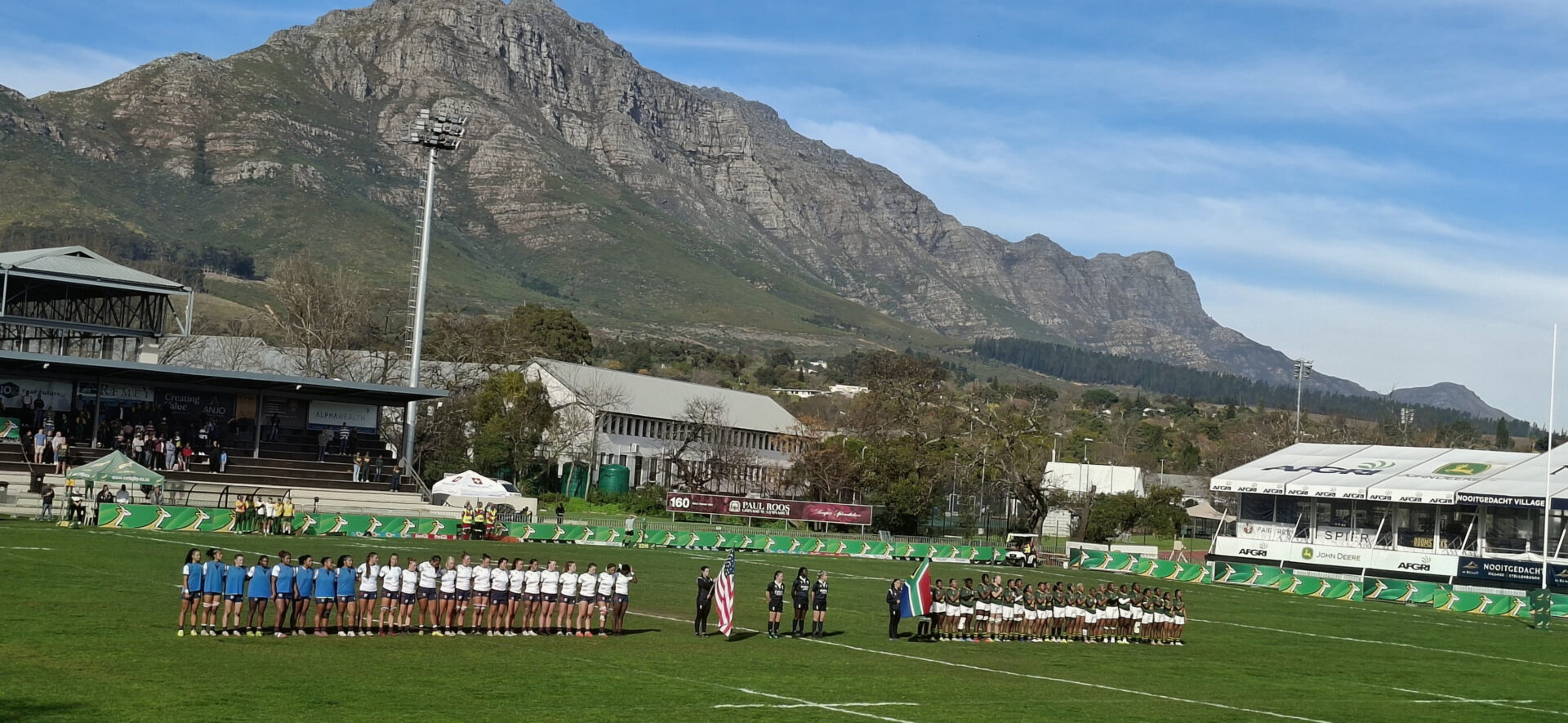
After two years away from international rugby, the Junior Springbok Women returned to the field in July 2026 not against a comfortable opponent, not in a low-stakes environment, but against one of the most competitive Under-20 sides in the world. Two matches. Two Fridays. The same venue. The Markötter Stadium in Stellenbosch. And they showed up for both.
That deserves to be said before anything else is said. That deserves to be celebrated before anything else is analyzed. Because showing up after two years, with limited preparation, against a USA side that outplayed them from the first whistle is not a small thing. It is an act of courage that the scoreboard does not measure and that mainstream sports coverage rarely acknowledges. She Was Here acknowledges it.
The Series — What Happened
Match 1 on 17 July 2026 was difficult. The USA Under-20 Women delivered a commanding first half performance, leading 33-0 at half time and eventually winning 47-12. The Junior Springbok Women were overwhelmed early, outmuscled, outmaneuvered and out-executed by a side that arrived with sharper systems and deeper game understanding.
But they did not quit. Julene Haas and Siphumelele Mdlalose scored tries for South Africa and those tries mattered. Not just on the scoreboard. But as proof that even in the heaviest moments, these women found a way through.
Match 2 on 24 July 2026 told a different story or at least the beginning of one. South Africa started well, with Jada Davids crashing over after seven minutes to give the Junior Springbok Women a 5-0 lead. They went into halftime trailing 31-10 having scored 10 first half points compared to zero in Match 1. Although the USA pulled away in the final quarter to win 60-17, the South Africans’ efforts were much better in the second match.
Tries from Jada Davids, Palesa Matee and Kaylin Heuvel, with Julene Haas converting one, told the story of a team that grew between matches. That learned. That adapted. That refused to be defined by the first result.
That growth — from zero first half points to ten, from being overwhelmed to leading early in Match 2 — is the real story of this series. And it deserves to be celebrated.
Who These Women Are
Before the criticism and there is honest criticism to be made, it is important to understand who these players are.
Several members of this Junior Springbok Women’s squad have competed in the premier division of South African women’s rugby. They are not beginners finding their feet. They are not players without experience or quality. They are young women who have already proven themselves at the highest level of domestic competition who arrived at this series having earned their selection through performance.
They were selected following the SA Rugby U20 Women’s Week in Alberton a competitive tournament that identified the best young female rugby players in the country. These are the best. And they showed it not always on the scoreboard, but in the way they competed, the way they responded, and the way they grew across two matches.
They also did so carrying something heavier than most people in the stands understood. These were the Junior Springbok Women’s first matches since 2024. Two years of waiting. Two years of training without the validation of international competition. Two years of wondering when the next opportunity would come. When it came they showed up.
The Honest Questions
Celebrating these women does not mean ignoring the questions their performances raise. In fact honouring them properly means asking those questions loudly. Because they deserve better than what the current system is giving them.
Some of these players have been attending national camps since late 2025 returning multiple times in 2026 before this series. On paper the preparation looked substantial. But camps without continuity do not build players. They maintain them.
When a player attends a national camp she is assessed. She is told what she does well and what she needs to develop. She leaves with a target. But when she returns to her union that target often gets lost. Not because the player is unwilling. But because the structures waiting for her at home are not always equipped to carry the work forward. Some of these girls go back to unions without structured development programs. They train. But training and developing are not the same thing. Without coaches at union level who understand and prioritize what was worked on at national camp the player arrives at the next camp almost where she left the last one.
Game knowledge is another area that requires honest conversation. Many young players in South Africa learn rugby by playing it, developing instinct without always building deep understanding of why certain decisions are made. Against a USA side drilled in game comprehension from a young age, that gap showed. It is not a talent gap. It is an investment gap. And it cannot be closed in two weeks.
There is also the question of identity. South African women’s rugby has a natural style physical, direct, ball-in-hand. They attempted a territorial game ,effective in theory but requiring years of drilling to execute under pressure. A good coach looks at what they have in front of them and builds from there. South Africa does not need to play like the USA to compete with them. South Africa needs to play like South Africa but better. More structured. More continuous in development. The roots are strong. The system around them needs to match that strength.
What They Gave Us Anyway
Despite all of it, despite the preparation gaps, the two year absence, the style adjustments, the heavy scorelines these young women gave everything they had across two matches in Stellenbosch. They scored tries. They led in Match 2. They improved visibly and measurably between the first and second game. Head coach Hayden Groepes committed from day one to giving every player in the squad an opportunity and every player who took that opportunity did so with pride.
They wore the jersey. They represented their country. They stood on a field against one of the world’s best and refused to be broken.
That is not failure. That is the beginning of something.
These women are the future of South African women’s rugby. And the future looks like players who grow between matches, who score tries against elite opposition, who show up after two years away and give everything they have on a warm winter afternoon in Stellenbosch.
The scoreboard said 47-12 and 60-17.
But She Was Here says something different.
She showed up. She competed. She grew.
And we will remember her for it.